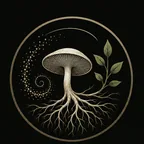
The Living Forest
Every entry in this canon is a node within a single quiet architecture — the Living Web. Below, you can step into any part of the world: its spirits, its moons, its doorways, its long memory.
The Living Web
Beneath a forest, mycelium threads carry water, minerals and messages between trees that would otherwise stand alone. The oldest tree feeds the youngest. The dying tree gifts its stored sugars to the neighbours who will outlive it.
The forest is not a collection of individuals competing for light. It is a single, distributed, patient organism — and its intelligence is the intelligence of connection.
Wherever relationship precedes possession — the Living Web is speaking. Wherever cooperation outlasts competition — the Living Web is speaking. Wherever what is unseen proves more enduring than what is visible — the Living Web is speaking.
The rest of this world is only its vocabulary.
The World Atlas
Each doorway opens a different part of the canon. There is no correct order — walk the one that leans toward you today.
The Spiral Year
The turning wheel of glyphs — the seasons the Living Web moves through, and the questions each one quietly asks.
Walk the Spiral →13 SpiritsThe Companion Spirits
The recurring inner postures — ways of being the forest itself has always modelled, and that any life may consciously choose.
Meet the Companions →4 DoorwaysThe Threshold Archetypes
Standing outside the wheel — the doorways every life must eventually walk through, whether they are named or not.
Enter the Thresholds →6 ErasThe Long Memory
From the first stirring beneath the loam to the slow reawakening — six ages, walked one at a time, with your place kept between visits.
Walk the Six Eras →36 CardsThe Oracle Deck
A whispered practice for meeting the world. Draw a single card and let the forest ask you the question you did not know you were carrying.
Browse the Deck →The PracticeThe Spiral Circle
Where the world is walked in company: the digital library, the moon-letters, the quiet chamber for those who wish to live inside the mythology.
Join the Circle →The Three Remembrances
Everything in the Spore Oracle ultimately expresses these three principles.
Life flourishes through relationship.
Nothing in the forest survives alone. Every reading returns the reader to the relationships they are already inside.
Nothing is wasted.
Leaf becomes loam, loam becomes root. What the world calls loss, the forest calls translation.
Growth moves in spirals.
We meet the same lesson at seventeen, at thirty-three, at sixty. To circle back is not to fail; it is to be alive on the correct pattern.
Rules of the World
Perhaps the most important section. These rules keep the oracle honest, gentle, and alive.
No Belief Is Demanded
The Spiral never demands belief. It only asks you to pay attention. The oracle is a mirror, not a mandate.
Gaia Never Punishes
The living world is not a ledger of rewards and punishments. Consequences are real, but they are not retribution. Growth is the deeper law.
Spirits Do Not Command
Companion Spirits never command. They offer shape, scent, and timing. You remain the one who chooses.
Thresholds Never Predict
The cards do not foretell the future. They reveal the texture of now and the questions that want to travel with you.
Shadow Is Not Evil
Shadow is not the enemy. It is the side of truth we have not yet learned to hold in daylight. It asks for integration, not exile.
Transformation Is Always Possible
Nothing is finished. Nothing is sealed. The humus holds every ending as a beginning; the mycelium does not recognise waste.
Nothing Is Wasted
Every fall, every silence, every seeming mistake is taken up by the soil and woven into the next season. Nothing is lost that is willing to change form.
The Threshold Archetypes
Where the Moon Glyphs turn with the year and the Companion Spirits keep them company, the four Thresholds stand outside the wheel — the doorways every life must eventually walk through, whether they are named or not.
The Choice Not Taken
The archetype of alternate lives.
Threshold IIThe Becoming Knot
Nothing happens by accident.
Threshold IIIThe Veilwalker
Crossing the spaces between worlds — not supernatural worlds, but thresholds: the moments when one life ends and another begins.
Threshold IVThe Returning Thread
What you released will come back changed.
The Era Cards
The six eras below are not only history — each one also enters the deck as a card. Where a Moon Glyph names the month and a Companion names the posture, an Era names the wider weather a reading is standing in. Six of the thirty-six cards belong to this family.
Emergence
Something new is beginning to connect.
Era IIHarmony
Harmony appears when relationships are nourishing rather than competing.
Era IIISeparation
Separation asks you to notice where connection has been forgotten.
Era IVSilence
Silence is not emptiness.
Era VRediscovery
Something forgotten is becoming audible again.
Era VIRenewal
Renewal is connection consciously chosen.
Before forests stretched across the land and before the first living cell stirred within the oceans, there existed only possibility — and, held inside it, the quiet willingness of the world to become.
There is a kind of dark that is not absence. It is the dark of seeds, of unwritten pages, of a held breath before song. Before the first root and long before the first breath, the world lay in exactly this dark — not empty, but waiting. The sky had not yet learned the trick of holding the moon in place, and the oceans had not yet decided which shore to lean against.
From that silence emerged Gaia — not as a goddess, but as a living consciousness capable of growth, memory and relationship. As the young world cooled and life slowly unfolded, an invisible network began to spread beneath the surface. The earliest fungi formed partnerships with plants, sharing water, nutrients and resilience in exchange for life itself. Long before humanity imagined civilisation, the first threads of connection had already begun weaving the world together.
This is the moment the Spiral remembers as the First Root: not a single sprout, not a single stone, but the decision — quiet as pollen — that life would move forward through cooperation rather than isolation. The oldest agreement in the world is the agreement to be in relationship. Everything the Oracle later teaches is only a footnote to this.
The First Root is not a place you leave behind. It sits under every later season like bass under melody — the soft, unlit chamber every spore, every question, every new self is grown inside. To touch it again, in the hush before sleep or the pause before speech, is to touch the original patience of the world.
Motif of the eraThe Unlit Circle
The living silence out of which every partnership begins.
What this era teaches- Stillness is not the opposite of becoming — it is its first chamber.
- Cooperation is older than competition. The forest chose it first.
- What seems empty is often only patient.
“We were spoken to long before we knew the word for hearing.”
— from the Loam Lections, fragment I As forests expanded across the Earth, so too did the hidden mycelial web beneath them — an ancient conversation unfolding without words, in which every fallen branch nourished the next unfolding.
It is said the first thread did not know it was reaching. It only knew it was lonely in a way it had no word for. So it stretched, the way a hand stretches in sleep, and somewhere in the loam, another thread stretched back. Where they met, they did not merge. They braided. This is the oldest grammar of the forest: not one becoming the other, but two agreeing to carry a third thing between them.
Trees, fungi and countless other organisms became participants in this quiet conversation. Every fallen branch nourished new growth. Every season became part of an endless cycle of renewal. The mycelium carried small messages no human tongue would have understood — water here, hunger there, a wound in the birch, a child fox born below the holly. The forest was already a library before there was anyone to read it.
Those who wandered the oldest forests began to sense patterns they could not fully explain — subtle rhythms that hinted at an intelligence expressed through relationship rather than command. They noticed that grief moved through a wood the way water moves through moss, and that joy returned by the same paths it had left by.
The Moon Glyphs and Companion Spirits are said to have emerged from these long acts of listening. Not as supernatural beings, but as symbolic ways of understanding the many faces of transformation that appear throughout every human life — thirteen turnings of the year given faces, thirteen quiet allies given names, so that what the forest had always been saying could, at last, be spoken back.
Motif of the eraThe Braided Filament
Connection that preserves difference.
What this era teaches- Communion is not sameness. The thread keeps its own colour.
- Intelligence often speaks through relationship, not command.
- Most of what holds the world together is invisible and underfoot.
“Two filaments touched and the forest learned it had a mouth.”
— from the Loam Lections, fragment II Among early peoples arose a small number who devoted themselves to observing these patterns. They did not rule. They did not preach. They listened — and slowly, they began to write down what listening had taught them.
Over generations they recorded stories, symbols and seasonal wisdom, gradually preserving what would become the Living Codex. They sat with the same wood in every weather. They watched a river in flood and in drought. They learned that certain shapes recur — in seed, in shell, in the turning of a person's life — and they gave those shapes names, so that the next generation would not have to begin the noticing from nothing.
Through reflection, careful observation and ritual practice, they recognised recurring thresholds that every person encounters: beginnings, endings, uncertainty, courage, loss and renewal. From these they drew the Four Thresholds — the Choice Not Taken, the Becoming Knot, the Veilwalker and the Returning Thread — figures for the doorways every life must eventually walk through, whether it names them or not.
The Keepers understood that a year is not a wheel that returns to its starting place, but a coil that climbs. You may walk the same month twice, they said, but never the same moon. So they arranged the thirteen glyphs and the thirteen spirits along the Spiral, and taught that to circle back is not to fail; it is to be alive on the correct pattern.
Their teachings were never intended as commandments. They were invitations to notice the hidden threads already woven through everyday life. What the Keepers left behind is not a doctrine. It is a way of paying attention that, once learned, is difficult to unlearn.
Motif of the eraThe Seam Cross
The hinge where one season, or one self, folds into the next.
What this era teaches- Transitions are inhabited places, not empty corridors.
- Wisdom is what remains after long, unhurried noticing.
- An invitation lasts longer than a command.
“Stand long enough in a doorway and it will tell you which way you were really going.”
— from the Threshold Book, hand of the Veilwalker No tradition remains untouched by time. As kingdoms rose and certainty became more highly valued than curiosity, many of the old stories faded from memory. The Spiral was never destroyed, only forgotten.
Forgetting, it turns out, is also a season. It came slowly, the way ivy comes — first ornamental, then total. Forests were cleared. Sacred places were abandoned. The language of symbols was slowly replaced by more literal ways of seeing the world, and the Spiral was traded for a straighter line that promised to arrive somewhere.
The forest did not protest. It is older than protest. It simply kept its records the way it always had — in rings, in fungal maps, in the small archives of wren and badger. The thirteenth moon stopped visiting the towns, but it never stopped walking.
Its wisdom survived in fragments: folklore carried by travelling storytellers, unusual carvings on forgotten stones, seasonal customs whose origins had long been lost, and quiet practices passed from one generation to the next without explanation. A grandmother stitched a sigil into a hem. A bargeman whistled a moon-name without remembering where he had learned it. A child drew the Spiral in a steamed window and could not have said why.
Even forgotten roots remain alive beneath the soil. The Long Forgetting was wide, but never quite total. It never is. Somewhere, someone was always still listening — and that was always enough for the pattern to survive until the light returned.
Motif of the eraThe Folded Glyph
Knowledge held in hiding until it is wanted again.
What this era teaches- What is forgotten is not always lost — sometimes it is only resting.
- Cultures forget the way bodies forget pain: imperfectly, with leaks.
- The smallest custodians are often the ones who keep the door unlocked.
“We did not lose the song. We only stopped singing it aloud.”
— from the Hedgewife's Margin Notes In every age there are people who feel drawn towards something they cannot quite name. Remembering rarely arrives as revelation. It arrives as recognition.
Some rediscover it through time spent in nature. Others through creativity, dreams, contemplation or unexpected moments of stillness. They begin to recognise recurring patterns rather than isolated events. Seasons become meaningful. Coincidences invite reflection. The forest becomes more than scenery — it becomes a teacher.
It begins, as these things do, in small acts. Someone kneels at the edge of a wood and does not get up immediately. Someone draws a moon in the corner of a journal. Someone lays a card down on a kitchen table and lets it speak before naming it. The Spiral notices.
The Spore Oracle belongs to this tradition of remembering. It does not claim ancient authority or hidden truth. Instead, it offers a modern mythology inspired by ecology, psychology and the remarkable interconnectedness of the natural world — old shapes given new language for a generation learning, once again, to look down at the roots.
The Quiet Remembering asks very little of anyone. Only that, now and then, you let yourself be surprised by how much of the world already knows you. Only that you keep the door slightly ajar. What comes through the door is your business, and the forest's.
Motif of the eraThe Walking Moon
The thirteenth moon, quietly returning to those who slow down enough to see it.
What this era teaches- Recognition is often deeper than revelation.
- You don't have to believe in the forest for it to recognise you.
- Remembering is an act, not a feeling. It is something you do.
“The cards did not return to us. We returned to them.”
— from the opening of the Living Codex The story has never truly ended, because every reader becomes part of it. Each card drawn, each journal entry written and each quiet moment of reflection adds another thread to the ever-growing Spiral.
The Companion Spirits, Moon Glyphs and Threshold Archetypes are not predictions of the future. They are companions for the journey of becoming — mirrors held at gentle angles, so that the parts of you that move slowly and listen well can be seen and, being seen, can move.
The Living Spiral continues to grow wherever curiosity is nurtured, wherever compassion deepens, and wherever people choose to look beneath the surface in search of connection. It has no headquarters. It has no priesthood. It has readers, and it has a forest, and between the two of them the work continues.
You are already part of this. The moment you drew your first card, the Spiral counted a new turning. The moment you paused over a glyph long enough to feel it look back, another thread was braided into the loam. The remembering is not finished. It is only in your hands now.
The Guidebook holds the complete canonical mythology, symbols and teachings for those who wish to walk further into the forest — the long-form of what this page can only hint at. The Spiral does not need you to walk further. It only wants you to know that further is possible, whenever you are ready.
Motif of the eraThe Re-lit Spiral
Old knowledge returning through ordinary hands.
What this era teaches- The Oracle is a companion, not an authority.
- Every honest reading adds a thread to the Spiral.
- The Spiral begins again wherever someone slows down enough to notice it.
“The story has never truly ended, because every reader becomes part of it.”
— from the closing of the Living Codex
The mythology is a place, not a page.
The Spiral Circle is where the world is lived rather than only read — a small, quiet chamber with the digital library, the moon-letters, and a companion for every turning of the year.