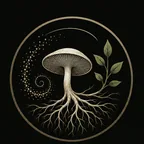
Mushrooms have meant more to human beings than almost any other organism their size. They have been doorways, teachers, poisons, sacraments, companions of the dead, and — most recently — a scientific revolution in how we understand what a forest actually is. For a fruiting body that lives a week and stands three inches tall, that is a great deal of meaning.
This guide walks briefly through what mushrooms have symbolised across cultures, and what those meanings can still offer to a modern practice — an oracle draw, a walk in the woods, a moment of noticing.
Mushrooms as doorways
In folk traditions across northern Europe, a ring of mushrooms in the grass marked a place where two worlds touched. To step inside a fairy ring was to risk being kept there; to eat what grew inside one was to risk being changed. The mushroom was liminal — it belonged to neither world. This is still the most common spiritual meaning attached to mushrooms in the western imagination. When one appears in a dream, a card, or a story, it often signals a threshold.
Mushrooms as teachers
In the mountain traditions of central Mexico, certain mushrooms were addressed as elders. They were consulted about grief, illness, and the location of lost things. This is not the same as the recreational framing that has followed in modern culture — the mushroom was treated as a person, spoken to by name, and asked for guidance. The spiritual meaning here is instructional: the mushroom knows something the human does not, and the practice is to listen.
Mushrooms as hidden connection
In the last fifty years, mycology has revealed the meaning that human beings had been sensing for millennia without being able to name. The mushroom is the visible tip of a vast underground network — the mycelium — that connects trees, carries messages, and holds forests together. Symbolically, the mushroom now stands for the hidden infrastructure of any life: the friendships beneath the friendship, the years of work beneath the visible achievement, the grief composting quietly beneath the good day. The visible thing is not the important thing.
Mushrooms as decay and return
Mushrooms feed on the dead. They are the organism that takes a fallen tree back into the soil. In symbolic terms, this makes them the patient companion of endings — the figure that turns loss into next year's growth. Draw a mushroom card in a season of grief and it is rarely a curse. It is usually the deck's quiet way of saying: this too is composting into something you cannot yet see.
How the Spore Oracle uses these meanings
The deck's thirteen Companion Spirits each carry one strand of mushroom symbolism. Mycorth is the network beneath. Rootfather is the enduring stewardship. Fallmire is the honest work of ending. Ashveil is the faithful witness after the fire. If any of the meanings above spoke to a moment in your own life, the Companion Spirits page shows which card holds it.
You do not have to believe mushrooms are magic to be shaped by these meanings. You have to be willing to notice, on a walk, that the small pale thing on the log has been carrying human meaning for six thousand years. That noticing is most of the practice.
If you want to begin one, draw a card here. The mushroom you meet will already know what to do.