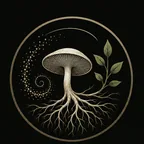
Mushrooms have carried meaning for as long as human beings have knelt in wet leaves. They are the visible edge of an invisible body. They arrive after rain, disappear in a week, and hold together forests that outlive empires. Long before anyone drew a card with a mushroom on it, mushrooms were already an oracle — small, insistent messages from a slower world.
This field guide walks through what mushrooms have symbolised across cultures and centuries, and how each of those meanings walks into the Spore Oracle deck as one of the thirteen Companion Spirits. If you are new to the deck, this is a good place to start. If you have been reading with it for a while, this is the essay that names the pattern you have already felt.
A short history of what mushrooms have meant
In the folk traditions of northern Europe, mushrooms were the doorway. A ring of them in the grass marked where the other world touched this one. To step inside a fairy ring was to risk being kept there. To eat what grew in one was to risk being changed. The mushroom was not evil — it was liminal. It stood on the edge of two worlds and refused to say which side it belonged to.
In the mountain traditions of central Mexico, certain mushrooms were teachers. They were spoken to as elders, addressed by name, and consulted about grief, sickness, and the whereabouts of missing things. The mushroom was not a drug in this frame. It was a small, quiet person who lived under the pine needles and knew the answer.
In the mycological understanding that only arrived in the last fifty years, the mushroom is the tip of something enormous. The visible cap is the fruit. The real organism is a lace of white threads — mycelium — running for hundreds of metres beneath the forest floor, feeding trees, carrying messages, and quietly holding the woodland together. The mushroom, in this frame, is a symbol of hidden connection. The visible thing is not the important thing. The important thing is the network you cannot see.
The Spore Oracle draws on all three of these traditions. The Companion Spirits are doorways and teachers and threads of a hidden network. Each one carries a piece of what mushrooms have meant to human beings, and gives it a name you can hold in a morning draw.
The thirteen Companion Spirits and their symbolism
Mycorth — deep foundations. Mycorth is the mycelium itself — the underground network, the patient infrastructure, the part of any life that no one sees. Draw Mycorth when the visible progress in your life feels small. The real work is happening underground.
Solmara — patient warmth. Solmara is the sun-fed mushroom, the amber-capped fungus that takes weeks to fruit and then feeds a whole clearing. She is the symbol of slow, sustaining generosity — the friend who never rushes and never runs out. Draw Solmara when you have been asked to give from an emptying cup.
Thawmire — gentle release. Thawmire is the mushroom of the first thaw, the one that softens the frozen ground so that other things can grow through it. She symbolises the slow letting-go — the grief that finally moves, the anger that finally cools. Draw Thawmire when something in you has been frozen too long.
Rootbinder — steadfast connection. Rootbinder is the mycorrhizal partner — the fungus that wraps a tree's roots and stays with it for a hundred years. He is the symbol of quiet, unwavering loyalty. Draw Rootbinder when you are being asked whether a relationship is worth staying inside.
Mirepetal — creative surrender. Mirepetal is the mushroom that grows out of the mire — the one that turns swamp into flower. She symbolises the creativity that only arrives after you stop trying to control the outcome. Draw Mirepetal when your work has become clenched.
Luneth — permeable presence. Luneth is the moon-lit mushroom, the one whose cap glows faintly in the dark. She symbolises the boundary that lets light through — the practice of being present without being defended. Draw Luneth when you have been armoured for too long.
Florovive — courageous flourishing. Florovive is the bright, brief, impossible-looking mushroom that fruits in colours no forest ought to produce. He symbolises the courage to be visibly alive. Draw Florovive when you have been shrinking to fit a room.
Solharvest — generous belonging. Solharvest is the harvest mushroom, the one that feeds the village. She symbolises the belonging that arrives when you feed others without keeping score. Draw Solharvest when you have been counting.
Fallmire — honest transition. Fallmire is the mushroom of the compost heap, the one that turns last year's tomatoes into next year's soil. He symbolises the honest work of ending — the willingness to let a thing be over. Draw Fallmire when you have been pretending something is not finished.
Ashveil — faithful witness. Ashveil is the pale mushroom that grows on burned ground. She symbolises the friend who stays after the fire — the one who does not try to fix the ruin, only sits beside it. Draw Ashveil when you need to be that friend, or need to find one.
Rootfather — enduring stewardship. Rootfather is the oldest mycelium in the forest, the one that has held the woodland together for centuries. He symbolises the long stewardship — the care that outlasts a single life. Draw Rootfather when you are being asked to plant something you will not see harvested.
Duskwell — quiet remembrance. Duskwell is the twilight mushroom, the one that fruits between one day and the next. She symbolises the small, deliberate act of remembering — a name spoken aloud, a photograph held. Draw Duskwell when something in your life needs to be honoured, not solved.
Glimroot — the hidden thirteenth. Glimroot is the intercalary Companion, the one who walks beside those between visible paths. He does not belong to a month or a season. He symbolises the company you find when you are in a life that has no name yet. Draw Glimroot when the ordinary categories have stopped describing you.
How to read mushroom symbolism in your own practice
There is no correct meaning for any of these Companions. The symbolism above is the deck's inheritance — what mushrooms have meant to the human beings who came before us. Your practice will add its own layer. After a year of daily draws, Mycorth will not mean what this essay says. He will mean what he has meant on your kitchen table, on your particular Tuesday mornings, in your particular life.
This is how oracle decks work. The symbolism gives you a starting point. The practice gives you a language. Between the two, over time, the deck stops feeling like a book and starts feeling like a friend who has been watching you for a while.
If you want to begin, the simplest way is a daily draw — one card, in the morning, without ceremony. Draw a card now if you like. Or read on: the Companion Spirits page has the full portraits, the Guide walks you through your first month of readings, and the Guidebook is the 115-page PDF that holds the whole deck in your hand.
The mushrooms will do the rest.